

- Mercury 3 is the most capable diffusion LLM ever released. Across a range of benchmarks, Mercury 3 outperforms GPT-6 Luna and Claude Haiku 5.5 while running 4–8x faster.
- More than 40 times the size of Mercury 1, Mercury 3 runs at comparable speeds over 1,000 tokens per second, challenging the assumption that greater intelligence requires slower inference.
- Early customers are already running Mercury 3 in browser use agents, interactive education, real-time search agents, and customer support.
REDWOOD CITY, Calif.--(BUSINESS WIRE)--Inception, the company behind the first commercial diffusion large language models (dLLMs), today announced Mercury 3, the most capable dLLM ever released. Mercury 3 demonstrates that dLLMs can scale without sacrificing speed, with quality on par or better than frontier speed-optimized models like GPT-6 Luna and Claude Haiku 5.5. It does this while maintaining inference speeds above 1,000 tokens per second.
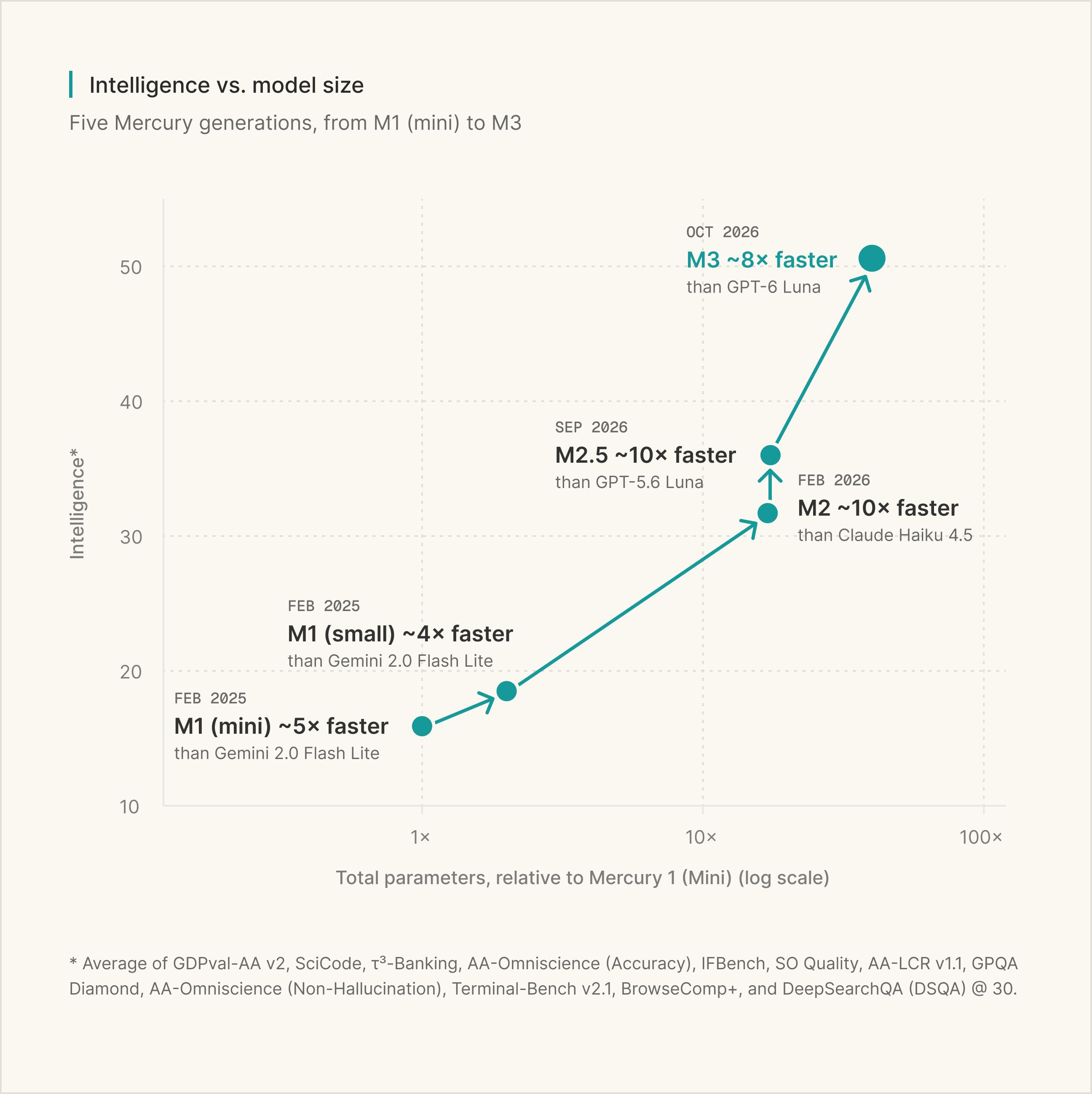
Mercury 3 is Inception’s fourth model release since launching Mercury 1 in June 2025, and each release has added capability without giving up speed. Mercury 2 introduced reasoning to diffusion models, Mercury 2.5 added tunable reasoning and a 260,000 token context window, and Mercury 3 delivers the largest jump in intelligence of any Mercury release and expands the context window to 1 million tokens.
Developers have faced a persistent trade-off when choosing AI models: smaller, faster models for latency-sensitive applications or more capable models that take longer to respond. Mercury 3 offers both. It outperforms GPT-6 Luna and Claude Haiku 5.5 on a broad range of standard benchmarks while keeping the speed of earlier Mercury models.
“Since we launched Mercury 1, the question we’ve heard most is whether diffusion can scale. Mercury 3 is over 40 times larger, significantly more capable, and still runs at over 1,000 tokens per second,” said Stefano Ermon, co-founder of Inception. “We’re showing that the limits to scaling diffusion models are compute and data, not fundamental algorithmic barriers. We’ve already started training our next model, and we expect to continue pushing intelligence forward without sacrificing speed.”
When Inception introduced Mercury 1, diffusion LLMs remained largely an academic pursuit, with early models limited to simple tasks like code autocomplete. Unlike traditional autoregressive models, which generate text sequentially, one token at a time, diffusion models can generate multiple tokens in parallel, offering a fundamentally different path to faster inference. The central question was whether this parallel generation advantage could be preserved as diffusion models scaled to higher levels of intelligence and more demanding tasks.
Mercury 3 at a glance
- Intelligence: On par or better than frontier speed-optimized models like GPT-6 Luna and Claude Haiku 5.5.
- Speed: More than 1,000 tokens per second on widely available NVIDIA GPUs.
- Scale: More than 40 times the size of Mercury 1, with comparable inference speeds.
- Context: A 1-million-token context window, up from 260,000 tokens for Mercury 2.5.
-
Price: $0.20 per million input and $0.70 per million output tokens.
- At launch, Mercury 3 is 50% off at $0.10 per 1M input and $0.35 per 1M output. Cached tokens are 90% off the input price.
Speed Where It Matters
Latency decides whether an interactive product feels responsive. In agentic systems, where a model makes repeated calls to finish one task, delays add up at every step. Mercury 3 lets teams use a more capable model in these workloads without slowing them down.
Early-access partners are already testing Mercury 3 in production workflows, including:
- Real-time applications: Interactive apps feel responsive only when the model keeps up with the user. Mercury 3 delivers results while the user is still engaged, whether that’s a tutor, a live assistant, a writing tool, or live translation.
- Agent loops: Agents wait on the model at every step, so small delays compound quickly. Mercury 3 keeps each pass fast, whether the agent is navigating websites, researching across sources, or analyzing logs and tracing incidents. Agents finish sooner and have time to try more approaches before answering.
"Mercury 3 allowed us to give every student instant feedback without giving up reasoning. Hints, marked answers and definitions now come back in about a second, with quality as good as or better than the models we ran before,” said Michael Tong, Co-founder/CTO, General Learning aka RevisionDojo. “When a student is stuck on a question, that speed keeps them working instead of waiting, and it was a drop-in swap for our existing stack."
Mercury 3 is available today through the Inception API, Baseten, OpenRouter, and Vercel. Because it is OpenAI API compatible, teams can switch to it without rewriting code. Enterprise deployments support dedicated capacity, autoscaling, compliance controls, and configurable data retention.
About Inception
Inception develops diffusion-based large language models (dLLMs) designed for efficient, low-latency AI applications. While traditional autoregressive LLMs generate text sequentially, Inception’s diffusion-based models generate outputs in parallel, enabling faster inference and improved reliability for real-time use cases like search, voice, and coding agents. Inception's Mercury models are available via the Inception API, OpenRouter, and Baseten. Based in Redwood City, California, Inception is backed by Menlo Ventures, Mayfield, Innovation Endeavors, M12 (Microsoft’s venture capital fund), Snowflake Ventures, Databricks Ventures, and individual backers including Andrew Ng, Andrej Karpathy, and Eric Schmidt. For more information, visit www.inceptionlabs.ai.
Contacts
Press Contact
Diana Vicinanza
VSC, on behalf of Inception
inception@vsc.co