

The new cushion line introduces a 3D-printed, variable-density lattice technology alongside a dual-density foam option, purpose-built for wheelchair users with significant postural needs
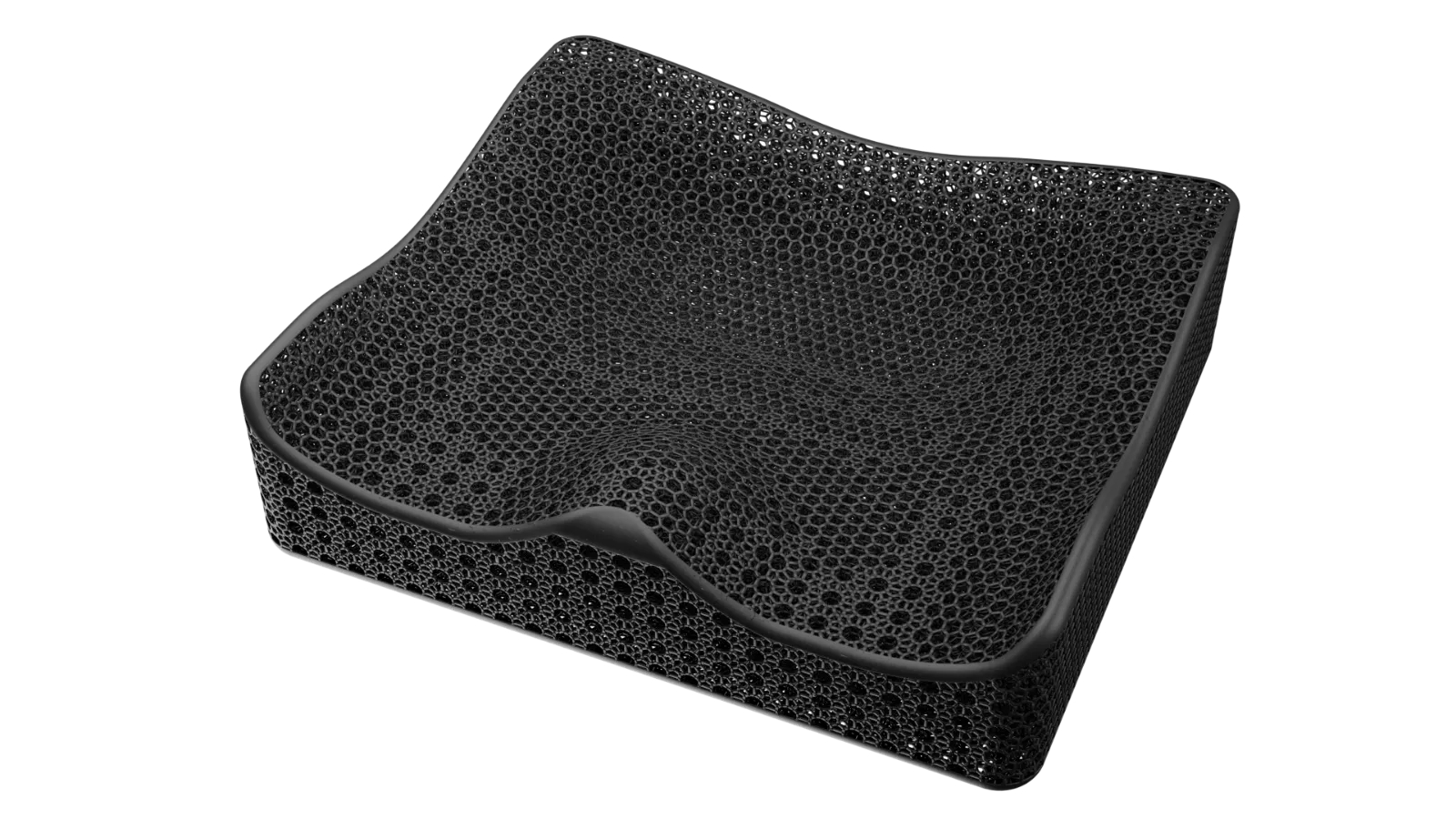

MELBOURNE, Fla.--(BUSINESS WIRE)--Kalogon, the market leader in smart seating solutions, today announced the launch of Verro – a new Medicare-coded custom wheelchair cushion line designed for people with significant postural support needs. Available in two models – Verro variable-density lattice (Verro Lattice) and Verro dual-density foam (Verro Foam) – Verro is built for wheelchair users whose bodies require a precise, body-conforming fit that standard cushions can’t deliver, including those with windswept posture, pelvic obliquity, or asymmetry.
At the core of Verro Lattice and new to the complex rehab tech market is Kalogon’s patent-pending variable-density lattice technology – a 3D-printed elastomer construction that varies firmness across the cushion surface: firmer where the body needs to be held in position, and softer where pressure needs to be diffused. For those who want more adaptability after fitting, Verro Foam is also available, with a dense foam base and soft foam topper (dual-density).
“We kept hearing from clinicians that their most complex patients were falling through the cracks, so we developed a technology that lets us 3D print the cushion with precise, localized control over where the body gets support and where it gets relief,” said Tim Balz, CEO and founder of Kalogon. “With our variable-density lattice, we can create subtle variations across the surface and sides of the cushion that simply aren’t possible with traditional materials. The customization options are hyper-personalized to provide the best comfort, support and fit for every customer.”
Verro's Two Cushion Constructions for Diverse Needs: 3D-Printed Variable-Density Lattice Technology and Dual-Density Foam
Seating specialists can order Verro in two construction types suited to different user needs and clinical approaches:
- Verro Lattice is 3D-printed from a high-performance, lightweight elastomer material, in a proprietary variable-density lattice that varies firmness across the surface. The open lattice lets air move freely through the cushion, helping with temperature and moisture management and making the cushion up to two pounds lighter than the average cushion. The material is hydrophobic, so liquids pass through rather than pooling around the client, and the cushion is safe for the top rack of the dishwasher. This variant comes standard with a vapor-permeable outer cover; an incontinence liner is available as an add-on.
- Verro Foam features a custom-cut dense foam base overlaid with a soft foam topper, creating a custom base with added support. Critically, the base can be carved and adjusted after delivery, giving seating specialists flexibility if a user’s needs change over time. An incontinence liner is included.
Together, the two Verro construction options cover a wide range of user needs and clinical preferences. Users who prioritize breathability and temperature regulation tend to do well with the lattice construction. Seating specialists who want the ability to modify after fitting or who are working with users new to contoured seating often prefer foam.
Two Ways to Order Verro: 3D Scan or Made-from-Measurement
Every Verro cushion starts with a precise capture of the user’s body. Clinicians can order in one of two ways on Launch Pad, Kalogon’s interactive real-time configurator:
- A 3D scan taken from a physical mold of the user in their desired seated position, offering the most intimate fit and empowering seating specialists to choose the shape that works best
- Detailed measurements entered directly into Launch Pad, giving seating specialists a familiar, accessible workflow
Regardless of which path a clinician chooses, Kalogon ships within 14 days of receiving the order – a fraction of the typical industry turnaround.
“Every client is different, and seating specialists need options that reflect that. Verro gives us more ways to match the right solution to each unique person based on their postural support needs, personal preferences and desire for in-field modification,” said Kelly Waugh, MA, PT, ATP, advisor to Kalogon. “That flexibility will allow Kalogon to serve a much wider population of people with complex seating needs than before.”
Verro carries the E2609 Medicare code and represents a deliberate expansion of Kalogon’s product line, offering a variety of materials and solutions for a wide range of clients who need custom seating. All cushions are manufactured in-house at Kalogon’s Melbourne, Fla., facility. Clinicians and seating specialists can order Verro by contacting Kalogon at Kalogon.com.
About Kalogon
Kalogon is the trusted leader in seated health, delivering inventive seating solutions that eliminate the stresses of sitting. Driven by clinical research, deep customer empathy and rapid product iterations, Kalogon’s solutions serve anyone who sits for extended periods, across healthcare, aviation and beyond. Kalogon’s proprietary technology combines real-time sensors, adaptive surfaces and personalized control to restore circulation, protect skin integrity and reduce fatigue. Founded in 2019 and headquartered in Melbourne, Fla., Kalogon manufactures all products in-house and serves customers through clinical partnerships, major DME distributors and direct sales. For more information, visit www.kalogon.com.
Contacts
Media contact:
Heather Sliwinski, Changemaker Communications for Kalogon
press@kalogon.com